
Advocate Duma Gideon Boko
August 17, 2026The Architecture of Citizen Capital
August 17, 2026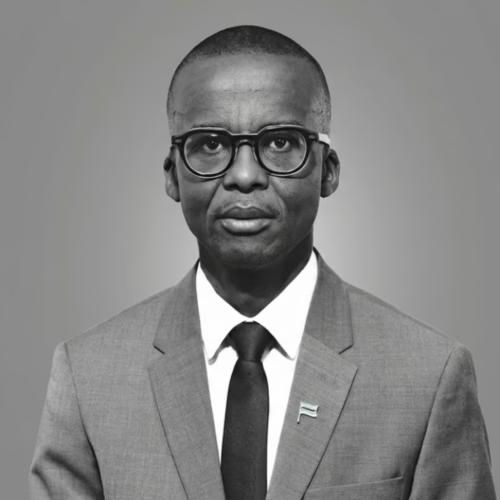
You often speak of the “New Botswana.” What does this vision mean to you?
“New Botswana” is not a rupture with our past, but the flowering of ideals that have guided us since before independence. It is a rediscovery of the noblest spirit of our forebears, their sense of duty, humility, and solidarity and a deliberate reimagining of what our nation can become in the century ahead. In 1966, Botswana stepped onto the world stage with almost nothing but faith, faith in democracy, in peace, and in one another. Generations of Batswana carried the fire of perseverance as cattle herders, miners, teachers, mothers and fathers contributing in ways that may not be recorded in modern literature, but are etched into the living memory of our land.
The New Botswana honours that inheritance but refuses to be constrained by it. It is the dawn of a nation awakening with moral clarity, urgent purpose, and bold imagination. It is defined not merely by economic models, but by a new cultural ethic of excellence, fairness, transparency and delivery. It is the shift from promises to performance, from rhetoric to measurable results, from dependency on minerals to a diversified, knowledge-driven, and innovation-led economy.
Anchored in the Botswana Economic Transformation Programme (BETP) and the National Development Plan 12 (NDP 12), this vision is no longer abstract; it is the architecture of a future where institutions serve with integrity, leaders listen with humility, and citizens are co-authors of transformation. The New Botswana is also Africa’s renaissance expressed through what we hope will turn out to be the best-managed nation on the African continent, a paragon of good governance, unity, and shared prosperity.
1966 and Now. Do you see it as a second founding moment?
When we attained independence in 1966, we were a people with little more than the dignity of our spirit and the strength of our belief. We believed in peace when others foresaw discord. We believed in democracy when others doubted its roots could take hold in African soils. Out of that belief, we planted the seeds of institutions, discipline, and unity that have endured.
Today, we stand at what I call a second founding moment. The first covenant was about survival and nationhood. This second covenant must be about a re-imagined society and economy that brings out the best in our people, one that nourishes the idea of inclusive prosperity, one that is fair and brings us together as a people.. The mineral model, though it carried us with dignity, cannot take us where our children must go. The future demands that we marry the wisdom of our elders with the imagination of our youth.
This moment requires a new architecture of progress, one built on execution, equity, and enterprise. Execution, because vision without discipline delivers nothing. Equity, because a nation rises only when all her sons and daughters rise together. Enterprise, because innovation, creativity, and entrepreneurship will carry us beyond diamonds to the frontiers of digital technology, agritech, green energy, and logistics.
This new covenant is mostly enshrined in the newly launched transformation program and cemented in the NDP 12 and many other reforms that will follow, ensuring that we are not only planning for survival, but building intergenerational prosperity. Botswana is being called not just to safeguard her democracy, but to inspire the African continent as a wellspring of wisdom and courage.
The Future Horizon
When you envision Botswana in 2040, what do you see, hear, and feel?
. By 2040, Botswana will be a nation dignified by work that ennobles, rooted in knowledge, powered by innovation, and guided by conscience. From young coders in Gaborone shaping Africa’s digital gateways to women-led cooperatives in Tsabong weaving prosperity into community life, the quiet confidence of a people served with integrity will define our national character. Importantly, Botswana will bring out the best in her people, empower them to reach out and achieve their purpose and find fulfilment. Fulfilment transcends the material; it is also about cultural and spiritual expression.
This is the New Botswana, a land of solar cities, fast trains, and digital corridors, a logistics hub for the region, a cradle of innovation, and a beacon of Pan-African cultural diplomacy. It is the Botswana where fairness is lived, dignity is shared, and prosperity is the inheritance of all.
Our True North points us toward this destiny, which is a high-income Botswana that is digitally-enabled, export-driven, economically diversified, and where every citizen is meaningfully employed, empowered and fulfilled. Agriculture, manufacturing, infrastructure, financial services, digitalisation, tourism, energy and mining, and the social sectors will be the engines that power this transformation. Through them, we will secure food sovereignty, build industries of excellence, connect markets, unleash innovation, share our natural and cultural treasures, power our future, and guarantee dignity for every citizen.
In 2040, Botswana will not only stand as a prosperous nation, but as a light on the hill for Africa, a living testament that a small, principled country can illuminate the path of renewal for a continent and offer its wisdom to the world.
What values must define leadership in the New Botswana?
Leadership in the New Botswana must be anchored in discipline, humility, fairness, and delivery. For too long, Africa’s story has been written around strong men who rise and fall, but Botswana’s destiny must be different. Ours must be the story of strong institutions that endure beyond individuals, of a culture where corruption finds no sanctuary, and where every decision is measured against the covenant of intergenerational prosperity. That is why we are strengthening oversight institutions and creating platforms for citizens to hold leaders accountable.
But leadership is also about memory and foresight. To the past, we owe gratitude to those visionaries who laid the foundations of roads, schools, democracy, and peace. We honour them not by imitation, but by preserving what is noble and reforming what no longer serves. To the future, we owe courage, the courage to rethink education, to invest in science, arts, and to build competitive firms and enterprises, to embrace digitalisation and equity as guiding principles, and to serve not for applause today but for prosperity tomorrow.
If we hold fast to these values, Botswana will not only secure her place as a high-income, digitally enabled, export-driven nation (our True North) but also stand as a light on the hill for Africa, a nation that draws wisdom from her past, courage from her present, and hope from her future.
Youth & Transformation
How do you reconcile Botswana’s tradition of steady governance with the need for urgent, transformative change, especially in the eyes of the youth?
Steadiness is not slowness; it is wisdom in motion. Our stability has been our shield for generations, but today it must become the launchpad for bold, urgent action. The youth are right to be impatient; theirs is a sacred impatience that challenges us to do what has never been done before. That is why we are driving the Botswana Economic Transformation with PEMANDU’s Big Fast Results methodology, disciplined, urgent, and measurable. It is not business as usual, but it is governance reimagined. Our tradition of steady hands now guides courageous leaps of diversifying beyond minerals, harnessing digitalisation, and opening new frontiers in agriculture, tourism, energy, and finance.
I have no doubt that Botswana will overcome today’s economic challenges, for the youth are forcing us to think outside the box, to build differently, and to lead with imagination. The Botswana of tomorrow will be the fruit of this moment, a nation that turns its steadiness into speed, its patience into progress, and its legacy into a future worthy of her youth.
What role should young people play in shaping national policy?
Our young people must not sit at the margins of policy, but they must be at its very heart. For generations, Botswana’s elders tilled the soil of democracy, stability, and unity. They built schools, roads, and institutions that gave us the platform on which we stand today. But every generation has a covenant to fulfil, and the covenant of this one is to ensure that the voices of our youth are not only heard, but woven into the very architecture of our nation’s future.
The youth must not just be beneficiaries of Botswana’s transformation; they must demand to be its co-authors. They bring the urgency of now, the mastery of new technologies, and the imagination of tomorrow. We are deliberately placing young people at the centre by rethinking education, scaling vocational training, reforming procurement, and opening pathways for entrepreneurship.
I do not see their impatience as a threat to governance, but as a gift, a sacred impatience that demands delivery. If properly harnessed, it will power the engines of our True North, a high-income, digitally-enabled, export-driven Botswana
Economy & Prosperity
Building Intergenerational Prosperity. What is the role of sovereign wealth?
For the latter years of Botswana’s first republic, if we might call it that, Botswana has faced a quiet but corrosive challenge where the government’s finances were bleeding. One of early assignments as a new Government is to halt waste, tighten controls, and restore the fiscal discipline that is the foundation of any thriving economy. We are making good progress but we are still some way off the level we intend to be.
Fixing the leaks is only the first step. The real test lies in what we do next. Sovereign wealth must not be treated as a rainy-day cushion for short-term consumption. Instead, it should be seen as seed capital for the future, a tool to transform our mineral wealth into engines of productivity that will outlast the mines themselves.
That means investing in infrastructure and clean energy, from solar farms and hydrogen corridors to the transmission lines that will power new industries. It means investing in research, education, and technical skills to make our youth globally competitive. And it means building industrial and agricultural value chains that create jobs, drive exports, and ensure lasting prosperity.
The shift is clear: Botswana is moving from short-term fixes to long-term value creation. Prosperity comes not from what we spend today, but from the productive capacity we build for tomorrow.
Beyond Minerals: How do you envision a sovereign economy?
The story of Botswana’s economic future cannot be written in diamonds alone. Minerals may have carried us this far, but they cannot carry us forever. A sovereign economy, one that is resilient, diversified, shock-proof, and inclusive, must feed itself, power itself, and export more than just raw commodities. This requires investing in the infrastructure, roads, logistics and digital platforms that unlock efficiency across every sector. It means securing energy sovereignty, transforming Botswana from an importer of electricity to a clean energy hub for Southern Africa. It means boosting agriculture so that our people eat what they grow, and rural communities thrive.
It also means diversifying into the digital frontier as ICT, fintech, and services that carry Botswana’s ideas and solutions beyond our borders. And it means building strong industrial value chains from the beneficiation of our minerals to green manufacturing corridors that generate real local wealth. A sovereign economy is not about isolation but about independence within interdependence. It is about standing strong in the global arena, anchored in skills, innovation, and self-reliance.
Leadership in Transformation. What qualities will be most important?
In times of change, leadership is tested not by noise, but by clarity. For Botswana’s transformation, leadership demands calmness, clarity, and focus. Ambition gives us the courage to imagine a Botswana that is sovereign and prosperous, far beyond the life of our mineral wealth. Restraint keeps us from spending recklessly or chasing populist applause. Conviction anchors us to principle, ensuring that every decision builds an economy meant to last longer than a political cycle. It is a sacred act to listen before acting, or to reflect before a major decision. The interests of the people, beyond the self, should be the moral compass., Discipline today is not a sacrifice; it is the price of prosperity tomorrow.
Closing reflection.
If you could offer a single, enduring message to every young Motswana today, a sentence that lives beyond your term, what would it be?
Whatever you choose to do, commit to turning it into gold. If you are not prepared to give it your whole heart and your whole strength, do not touch it at all. Life rewards those who transform ordinary assignments into extraordinary legacies, and that is the spirit I wish for every young Motswana to carry into the future.